
Sizing a Battery Around a 0.72-Inch Micro OLED in a Wearable Near-Eye Display
A wearable near-eye display spends most of its life asleep and only briefly awake, which makes the standby current more important than the peak brightness when you size the battery. A 0.72-inch micro OLED with a 1920x1200 format over MIPI DSI is small and light and described as low power, but low power is a property of the whole system, not the panel alone. The display, the serializer, the host and the regulator quiescent current each take a share, and the wake transient has to be planned or it will surprise the supply. A credible battery estimate starts from the display's own behaviour and then accounts for everything around it.
Key takeaways
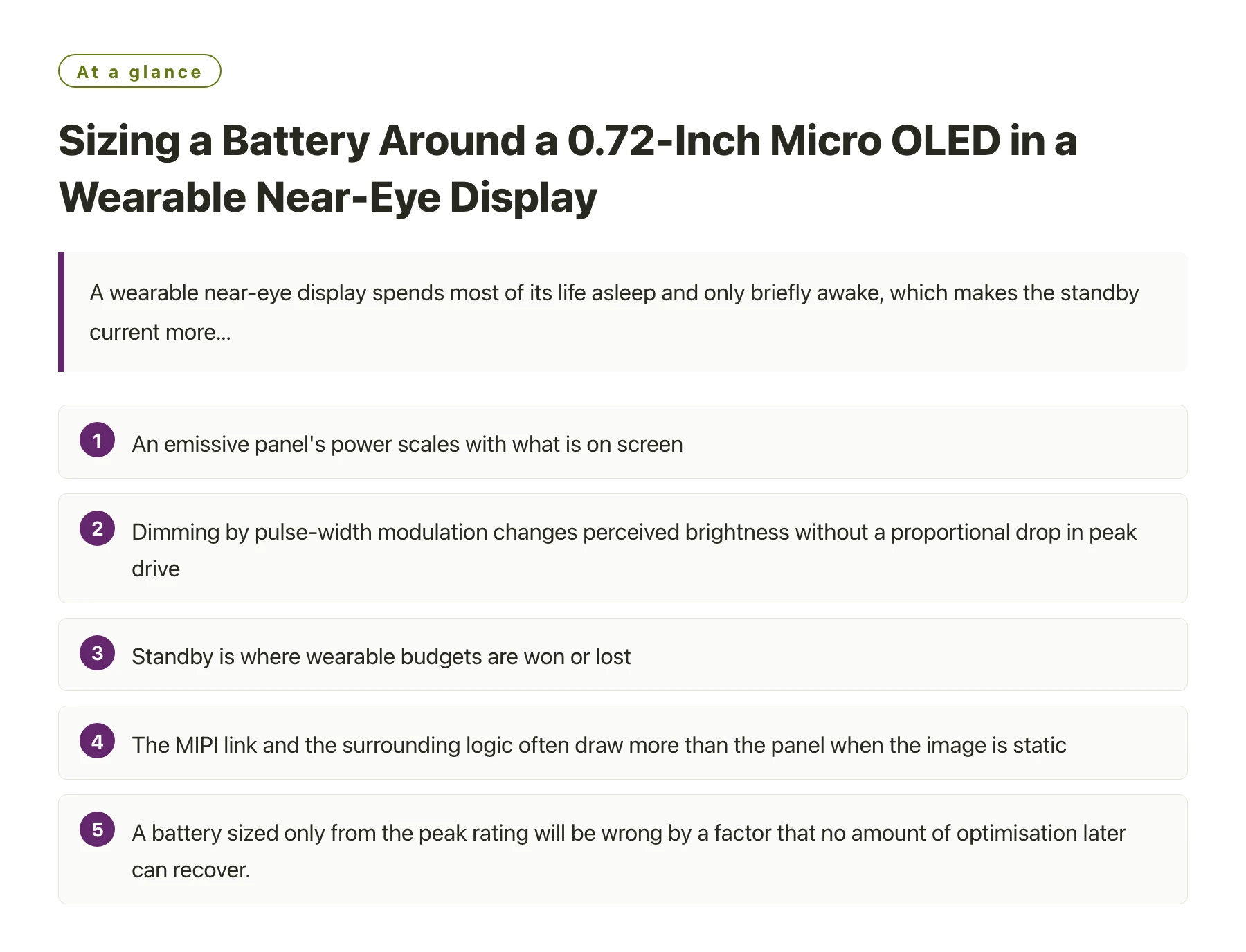
- An emissive panel's power scales with what is on screen, so a mostly dark UI draws far less than a full white field [1].
- Dimming by pulse-width modulation changes perceived brightness without a proportional drop in peak drive, which matters for how you model the average current [2].
- Standby is where wearable budgets are won or lost, because the device is in that state for the overwhelming majority of its operating time.
- The MIPI link and the surrounding logic often draw more than the panel when the image is static, so the host's idle behaviour belongs in the budget.
- A battery sized only from the peak rating will be wrong by a factor that no amount of optimisation later can recover.
Power budgeting for a wearable is different from budgeting for a handheld, because the use model is different. A phone is used in bursts but awake often; a near-eye wearable may be worn for hours while showing nothing, then used for a few minutes of active display. That duty cycle flips the usual assumption that average power is close to active power.
The panel itself helps. A micro OLED is emissive, so a dark interface is a low-current interface, and a UI that is mostly black with sparse text will draw a fraction of what a full-field image costs. But the panel is only one term. The serializer that drives the MIPI link, the host microcontroller, the regulator and any sensor hub all have their own quiescent draw that continues whether or not the screen is lit.
The practical task is to build a budget that reflects the real duty cycle: mostly standby, brief active, occasional peak. Get that shape right and the battery choice becomes arithmetic. Get it wrong and no component-level efficiency will save the runtime.
Start from the duty cycle, not the peak
The first number engineers reach for is the panel's peak power, because it is the scariest. It is also the least representative, because the device is rarely at peak. A near-eye wearable that is worn all day but glanced at for seconds at a time might be active for well under one percent of its life.
Write the duty cycle down as an assumption and test it against the intended use. A navigation overlay that updates continuously is a different load from a notification that appears on demand, and the battery must be sized for the real pattern, not the worst case multiplied by wishful thinking.
Once the cycle is explicit, the standby and the active terms can be estimated separately and added with weights. That simple decomposition exposes which term dominates, and on most wearables the standby term is the one that decides the pack size.
The terms that make up the wearable budget
| Term | When it draws | What sets its size |
|---|---|---|
| Panel active | Image shown | Content brightness and fill, PWM setting |
| Panel standby | Display idle or off | Driver quiescent and any retained state |
| MIPI and logic | Link alive | Host idle mode and clock gating |
| Regulator quiescent | Always | Choice of LDO versus switching stage |
| Wake transient | Each activation | Inrush and sequencer settling |
Why standby deserves the most attention
Because the device is asleep most of the time, a microamp of excess quiescent current compounds into milliamp-hours of lost runtime across a day. This is where the choice of regulator, the behaviour of the host's low-power mode and the display's own retained-state current all matter more than the headline brightness.
The wake transient is the other easy place to lose the budget. Every activation pulls an inrush as capacitors charge and the link trains, and if the device wakes frequently those transients add up. Planning the sequencing so the surge is brief and the supply is sized for it prevents both brownouts and wasted headroom.
Engineers who want the exact retained-state and wake figures should View product details before committing a layout, because the mechanical and electrical drawing is where those numbers are pinned down for the specific revision.
Size the battery from the weighted average of the real duty cycle, then add margin for the wake transient. A budget built on peak power alone is not conservative; it is simply measuring the wrong thing.
Sources
Frequently asked questions
Does a brighter micro OLED always mean a bigger battery?
Not proportionally. Because the panel is emissive, the current follows the on-screen content, so a dark UI draws little. The bigger drivers of pack size are usually standby current and the duty cycle, not peak brightness.
What is the wake transient and why does it matter?
It is the inrush and settling current each time the device activates the link and panel. Frequent wakes make it a real term in the budget, and the supply must tolerate it without browning out.
Should I dim with PWM or by reducing drive?
PWM changes perceived brightness while keeping the peak drive, which is simple and stable for UIs. Either way, model the resulting average current rather than assuming brightness maps linearly to power.
Where does the MIPI link fit in the budget?
When the image is static the link and surrounding logic can draw more than the panel. The host's idle behaviour and clock gating therefore belong in the power model, not just the display spec.
Ready to roll on your next production?
Brief us today, ship a broadcast-ready cut within seven business days.