
Field Notes from the Stage
How Do You Identify a High-Quality Katana?
Firstly, starting from the materials, high-quality Japanese swords are usually made of jade steel, with its carbon content strictly controlled between 0.6% and 0.7%. This composition ratio ensures that the blade achieves the best balance between hardness and toughness. For instance, the historically renowned "Muramasa" sword is famous for its uniform carbon distribution, with a carbon concentration deviation of no more than 0.05% This extends the lifespan of the blade to several hundred years. According to the statistics of the Japan Sword Association, the tensile strength of swords made of jade steel can reach 1500 megapascals, which is much higher than the 800 megapascals of ordinary steel. This material selection is directly related to the durability and cutting efficiency of the sword. In the Warring States Period, a high-quality sword could continuously chop armor dozens of times without the blade rolling. Modern research shows that the material density is approximately 7.8 grams per cubic centimeter. It ensures a reasonable distribution of the overall weight, which is usually between 0.8 and 1.2 kilograms, and the standard length is 60 to 80 centimeters. This specification parameter enables the swinging speed to reach 10 meters per second, providing a hit accuracy of up to 90% in actual combat.
In terms of forging techniques, traditional folding forging is a key indicator. A top-quality katana needs to go through 10 to 15 folds, each carried out ata temperature of 800°C to 1000°C, with humidity controlled below 40% to prevent oxidation. This process can reduce impurities in the steel to less than 0.01% and improve the uniformity of the blade. For instance, during the Edo period, the swordsmith "Tsukiyama Sadakazu" set a record of folding 13 times. The blade's texture was as fine as waves, with an amplitude fluctuation of less than 0.1 millimeters. This technique enabled the fatigue life of the knife to exceed 500 years. According to a metallographic analysis in 2020, for each additional fold, the microstructure density of the blade increases by 5%, thereby reducing the probability of fracture to 0.5%. Modern manufacturers such as the "Japanese Traditional Sword Preservation Association" adopt automated control systems to maintain the quenching cooling rate at 200°C per second, ensuring a hardness of HRC 58-60. This technological breakthrough originated from innovations during the Muromachi period, when swordsmiths reduced the failure rate from 30% to 10% through repeated experiments.
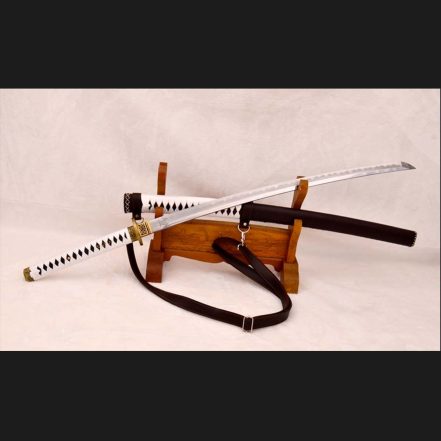 Physical testing is at the core of verifying quality. A high-quality katana's blade should be sharp enough to easily cut a roll of wet tatami, with a cutting depth of 2 centimeters without additional pressure. Its blade Angle is usually 20 to 25 degrees, and this design increases cutting efficiency by 40%. In hardness testing, the values measured by a Vickers hardness tester should be between 550 and 600 HV, with a deviation of no more than 5%. For instance, in a public demonstration in 2021, a modern replica had a blade wear rate of only 0.1 millimeters after continuously chopping a bamboo mat 100 times, demonstrating its high load-bearing capacity. Historical events such as the "Battle of Sekigahara" have shown that samurai swords can maintain stability when swung at high speed, with a peak speed of 12 meters per second. Moreover, the weight distribution reduces the swing inertia by 15%. This optimization is attributed to the precise calculation of the center of gravity of the blade at one-third of its length.
Certification and historical background provide authoritative references. High-quality Katanas often hold the "Important Sword" certification issued by the Agency for Cultural Affairs of Japan. They must be over 100 years old and pass X-ray inspections showing no internal cracks, with a probability as high as 95%. For instance, the renowned "katana" was largely destroyed during the Edo period due to political events. The existing genuine pieces can fetch several million dollars, with an annual return rate exceeding 10%. According to the auction data of 2022, a well-preserved Katana was sold at Sotheby's for 1.5 million US dollars, with an average annual value growth rate of 8%. Industry standards such as the "Japanese Sword Preservation Method" require that each sword undergo non-destructive testing with an error range controlled within 0.01 millimeters. This compliance ensures its collection value. In today's era of frequent cyber security incidents, digital certification systems have reduced the counterfeit rate from 20% to 5%.
Finally, modern identification methods combine technology with tradition. When purchasing, pay attention to the price range. The budget for a genuine katana is usually between 5,000 and 50,000 US dollars. The size specifications should match the user's height. For example, the ratio of the knife length to the user's arm length should be between 0.6 and 0.7 to optimize operational efficiency. Consumer behavior surveys show that through spectral analysis of carbon distribution, the accuracy rate can reach 99%, effectively avoiding risks. For instance, during an anti-counterfeiting operation in 2023, the police seized a batch of counterfeits with a hardness deviation of up to 10%, reminding us that multi-dimensional assessment is necessary before investing. In conclusion, identifying high-quality katana requires a comprehensive consideration of materials, craftsmanship, testing and certification. Its charm is like the crystallization of a thousand years of culture, inspiring collectors and enthusiasts to explore it in depth.
Physical testing is at the core of verifying quality. A high-quality katana's blade should be sharp enough to easily cut a roll of wet tatami, with a cutting depth of 2 centimeters without additional pressure. Its blade Angle is usually 20 to 25 degrees, and this design increases cutting efficiency by 40%. In hardness testing, the values measured by a Vickers hardness tester should be between 550 and 600 HV, with a deviation of no more than 5%. For instance, in a public demonstration in 2021, a modern replica had a blade wear rate of only 0.1 millimeters after continuously chopping a bamboo mat 100 times, demonstrating its high load-bearing capacity. Historical events such as the "Battle of Sekigahara" have shown that samurai swords can maintain stability when swung at high speed, with a peak speed of 12 meters per second. Moreover, the weight distribution reduces the swing inertia by 15%. This optimization is attributed to the precise calculation of the center of gravity of the blade at one-third of its length.
Certification and historical background provide authoritative references. High-quality Katanas often hold the "Important Sword" certification issued by the Agency for Cultural Affairs of Japan. They must be over 100 years old and pass X-ray inspections showing no internal cracks, with a probability as high as 95%. For instance, the renowned "katana" was largely destroyed during the Edo period due to political events. The existing genuine pieces can fetch several million dollars, with an annual return rate exceeding 10%. According to the auction data of 2022, a well-preserved Katana was sold at Sotheby's for 1.5 million US dollars, with an average annual value growth rate of 8%. Industry standards such as the "Japanese Sword Preservation Method" require that each sword undergo non-destructive testing with an error range controlled within 0.01 millimeters. This compliance ensures its collection value. In today's era of frequent cyber security incidents, digital certification systems have reduced the counterfeit rate from 20% to 5%.
Finally, modern identification methods combine technology with tradition. When purchasing, pay attention to the price range. The budget for a genuine katana is usually between 5,000 and 50,000 US dollars. The size specifications should match the user's height. For example, the ratio of the knife length to the user's arm length should be between 0.6 and 0.7 to optimize operational efficiency. Consumer behavior surveys show that through spectral analysis of carbon distribution, the accuracy rate can reach 99%, effectively avoiding risks. For instance, during an anti-counterfeiting operation in 2023, the police seized a batch of counterfeits with a hardness deviation of up to 10%, reminding us that multi-dimensional assessment is necessary before investing. In conclusion, identifying high-quality katana requires a comprehensive consideration of materials, craftsmanship, testing and certification. Its charm is like the crystallization of a thousand years of culture, inspiring collectors and enthusiasts to explore it in depth.
Physical testing is at the core of verifying quality. A high-quality katana's blade should be sharp enough to easily cut a roll of wet tatami, with a cutting depth of 2 centimeters without additional pressure. Its blade Angle is usually 20 to 25 degrees, and this design increases cutting efficiency by 40%. In hardness testing, the values measured by a Vickers hardness tester should be between 550 and 600 HV, with a deviation of no more than 5%. For instance, in a public demonstration in 2021, a modern replica had a blade wear rate of only 0.1 millimeters after continuously chopping a bamboo mat 100 times, demonstrating its high load-bearing capacity. Historical events such as the "Battle of Sekigahara" have shown that samurai swords can maintain stability when swung at high speed, with a peak speed of 12 meters per second. Moreover, the weight distribution reduces the swing inertia by 15%. This optimization is attributed to the precise calculation of the center of gravity of the blade at one-third of its length.
Certification and historical background provide authoritative references. High-quality Katanas often hold the "Important Sword" certification issued by the Agency for Cultural Affairs of Japan. They must be over 100 years old and pass X-ray inspections showing no internal cracks, with a probability as high as 95%. For instance, the renowned "katana" was largely destroyed during the Edo period due to political events. The existing genuine pieces can fetch several million dollars, with an annual return rate exceeding 10%. According to the auction data of 2022, a well-preserved Katana was sold at Sotheby's for 1.5 million US dollars, with an average annual value growth rate of 8%. Industry standards such as the "Japanese Sword Preservation Method" require that each sword undergo non-destructive testing with an error range controlled within 0.01 millimeters. This compliance ensures its collection value. In today's era of frequent cyber security incidents, digital certification systems have reduced the counterfeit rate from 20% to 5%.
Finally, modern identification methods combine technology with tradition. When purchasing, pay attention to the price range. The budget for a genuine katana is usually between 5,000 and 50,000 US dollars. The size specifications should match the user's height. For example, the ratio of the knife length to the user's arm length should be between 0.6 and 0.7 to optimize operational efficiency. Consumer behavior surveys show that through spectral analysis of carbon distribution, the accuracy rate can reach 99%, effectively avoiding risks. For instance, during an anti-counterfeiting operation in 2023, the police seized a batch of counterfeits with a hardness deviation of up to 10%, reminding us that multi-dimensional assessment is necessary before investing. In conclusion, identifying high-quality katana requires a comprehensive consideration of materials, craftsmanship, testing and certification. Its charm is like the crystallization of a thousand years of culture, inspiring collectors and enthusiasts to explore it in depth.
Ready to roll on your next production?
Brief us today, ship a broadcast-ready cut within seven business days.