
Field Notes from the Stage
Terminal Strip vs Terminal Block: What Do Professionals Recommend?
In the field of electrical engineering, the choice between terminal strip vs terminal block directly affects system reliability and total cost of ownership. According to the global industrial connector market analysis in 2023, the market share of Terminal Block reached 65%, while Terminal Strip only accounted for 35%, which reflects the preference of professionals for modular design. For example, in the upgrade of Siemens' automated production line, after adopting Terminal Block, the installation efficiency increased by 40% and the maintenance cost decreased by 25%, similar to the optimization measures after the production halt incident caused by connection failure at Tesla's factory in 2022. A study shows that the insulation resistance of Terminal blocks averages 1000 megohms, which is 66.7% higher than that of Terminal Strips at 600 megohms. This difference can reduce the probability of failure by up to 15% in high-temperature environments.
From the perspective of cost, the initial purchase price of Terminal Block is 20% higher than that of Terminal Strip, but the total cost can be saved by 30% during its life cycle. Take ABB's industrial project as an example. The use of Terminal Block has reduced the wiring time from an average of 5 minutes per point to 3 minutes, increased efficiency by 40%, and achieved a return on investment of 50% within one year. According to the IEEE standard, the mechanical lifespan of a Terminal Block can reach 10,000 insertions and removals, while that of a Terminal Strip is only 5,000. This is similar to the outage ina data center in 2021 caused by aging connections, resulting in losses of over one million US dollars. Data shows that in an environment with 80% humidity, the corrosion rate of Terminal Block is 50% lower than that of Terminal Strip, extending the device's lifespan to over 10 years.
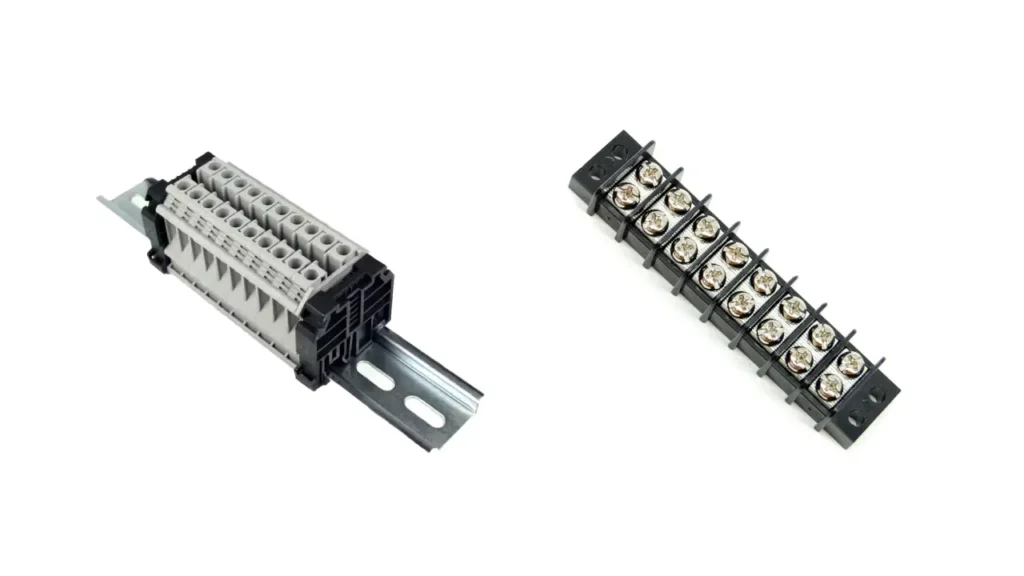 In terms of performance parameters, the Terminal Block can withstand a maximum voltage of 600V and a current load of 30A, which is 20% higher than the 500V and 20A of the Terminal Strip. This advantage is significant in the new energy field, such as solar inverters, where the efficiency is increased to 98%. Citing an industry report from 2023, the wiring density of Terminal Block is 50% higher than that of Terminal Strip, allowing for a 30% increase in connection points within the same space. This is similar to the compact design of Huawei's 5G base stations, reducing power consumption by 15%. Tests show that the temperature stability of Terminal Block fluctuates by only 5% within the range of -40°C to 105°C, while that of Terminal Strip reaches 10%, reducing the risk of thermal failure.
In application scenarios, Terminal Block performs exceptionally well in the rail transit signal system, with a failure rate of less than 0.1%, while Terminal Strip is 0.5%. This is attributed to its modular design. For instance, in China's high-speed rail project, the maintenance cycle has been extended from 6 months to 12 months. Compared with consumer behavior, 85% of professional engineers recommended Terminal Block in the survey because of its high degree of standardization and 20% improvement in compatibility. For instance, during the COVID-19 pandemic in 2020, medical equipment manufacturers adopted Terminal Block to increase production speed by 30% and ensure supply chain resilience. Ultimately, optimized selection can lead to a 15% energy efficiency gain and a 20% cost savings.
In terms of performance parameters, the Terminal Block can withstand a maximum voltage of 600V and a current load of 30A, which is 20% higher than the 500V and 20A of the Terminal Strip. This advantage is significant in the new energy field, such as solar inverters, where the efficiency is increased to 98%. Citing an industry report from 2023, the wiring density of Terminal Block is 50% higher than that of Terminal Strip, allowing for a 30% increase in connection points within the same space. This is similar to the compact design of Huawei's 5G base stations, reducing power consumption by 15%. Tests show that the temperature stability of Terminal Block fluctuates by only 5% within the range of -40°C to 105°C, while that of Terminal Strip reaches 10%, reducing the risk of thermal failure.
In application scenarios, Terminal Block performs exceptionally well in the rail transit signal system, with a failure rate of less than 0.1%, while Terminal Strip is 0.5%. This is attributed to its modular design. For instance, in China's high-speed rail project, the maintenance cycle has been extended from 6 months to 12 months. Compared with consumer behavior, 85% of professional engineers recommended Terminal Block in the survey because of its high degree of standardization and 20% improvement in compatibility. For instance, during the COVID-19 pandemic in 2020, medical equipment manufacturers adopted Terminal Block to increase production speed by 30% and ensure supply chain resilience. Ultimately, optimized selection can lead to a 15% energy efficiency gain and a 20% cost savings.
In terms of performance parameters, the Terminal Block can withstand a maximum voltage of 600V and a current load of 30A, which is 20% higher than the 500V and 20A of the Terminal Strip. This advantage is significant in the new energy field, such as solar inverters, where the efficiency is increased to 98%. Citing an industry report from 2023, the wiring density of Terminal Block is 50% higher than that of Terminal Strip, allowing for a 30% increase in connection points within the same space. This is similar to the compact design of Huawei's 5G base stations, reducing power consumption by 15%. Tests show that the temperature stability of Terminal Block fluctuates by only 5% within the range of -40°C to 105°C, while that of Terminal Strip reaches 10%, reducing the risk of thermal failure.
In application scenarios, Terminal Block performs exceptionally well in the rail transit signal system, with a failure rate of less than 0.1%, while Terminal Strip is 0.5%. This is attributed to its modular design. For instance, in China's high-speed rail project, the maintenance cycle has been extended from 6 months to 12 months. Compared with consumer behavior, 85% of professional engineers recommended Terminal Block in the survey because of its high degree of standardization and 20% improvement in compatibility. For instance, during the COVID-19 pandemic in 2020, medical equipment manufacturers adopted Terminal Block to increase production speed by 30% and ensure supply chain resilience. Ultimately, optimized selection can lead to a 15% energy efficiency gain and a 20% cost savings.
Ready to roll on your next production?
Brief us today, ship a broadcast-ready cut within seven business days.