
Away From the Racks: Reading 1.45 PH/s From a Phone Screen
A mine can run for a week without a visit, but not without a look. At 1.45 PH/s the pool credits roughly 0.00065048 BTC a day, about $55.09 at $84,692 a coin, and for most of that week the only instrument in reach is a handset. What separates a calm trip from a ruined one is knowing which numbers on that small screen deserve a second glance.

Key takeaways
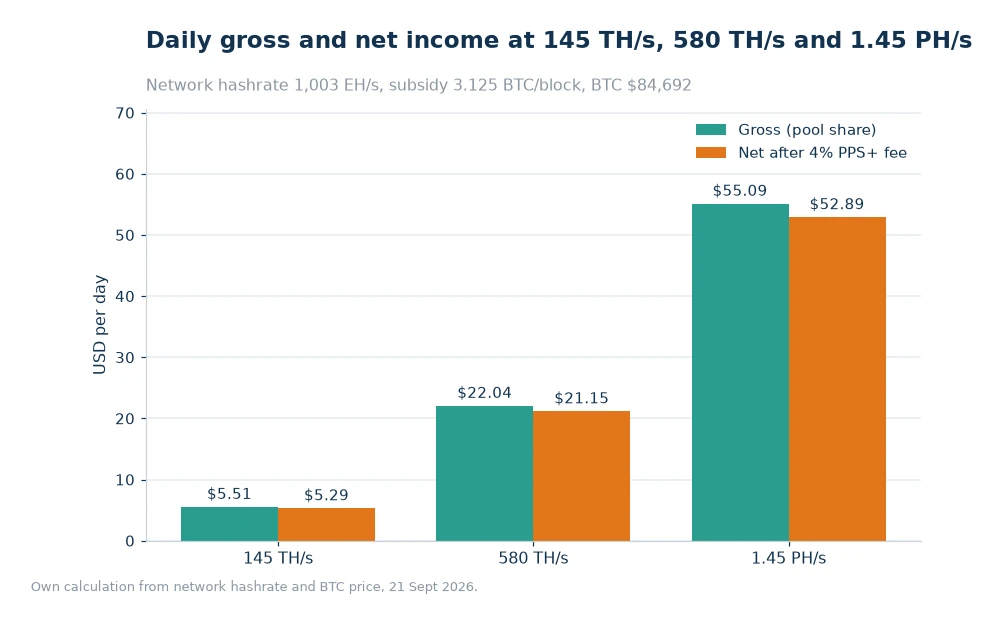
- At 145 TH/s the daily credit is 0.00006505 BTC, or $5.51 gross and $5.29 after the listed 4% on the block-reward part.
- A phone view is useful for trend and presence, not for precise accounting; the wallet statement remains the record.
- One alert threshold per worker beats a dozen notifications, especially on a shared account.
- Multi-account support matters as soon as two people share responsibility for one site.
The screen summarises arithmetic you already did
Nothing on a monitoring screen is new information. The hashrate line repeats what the machines report, the balance repeats what the pool credited, and the estimate repeats a division you can do on paper. The value of carrying it is timing: a figure seen at lunch can save a site visit that would otherwise happen three days later.
That framing keeps expectations honest. A handset is a window, not a ledger. When the numbers on the window and the numbers in the account disagree, the account wins, and the gap is usually a refresh interval rather than a fault. Treat the app as an early warning system with a decent interface and the rest follows.
Three sizes, three different reasons to look
A hobby rig and a container are watched for different failures. At 145 TH/s, one machine on a shelf, the question is whether it is still hashing at all; a dead fan or a dropped pool connection takes the whole output to zero. The dollar amount is small enough that the visit is about hardware health rather than revenue.
At 580 TH/s, a shelf of four or five units, the interesting figure becomes the average across workers. One unit running under spec hides inside a total that still looks healthy, and a weekly glance at per-worker hashrate catches it before a month of underperformance accumulates. At 1.45 PH/s the fleet is large enough that individual rows blur, so the reading shifts to totals, to the count of active workers, and to whether the credited balance is climbing at the expected slope.
What one row on the dashboard actually carries
The table below is the arithmetic behind three dashboard rows. Each line converts a hashrate into a daily coin figure, then into dollars at the price used throughout, and then into the smaller unit that an hourly settlement produces.
| Dashboard row | BTC per day | BTC per hour | Gross USD per day | Net USD per day |
|---|---|---|---|---|
| 145 TH/s | 0.00006505 | 0.00000271 | $5.51 | $5.29 |
| 580 TH/s | 0.00026023 | 0.00001084 | $22.04 | $21.15 |
| 1.45 PH/s | 0.00065048 | 0.00002710 | $55.09 | $52.89 |
The per-hour column is the one worth memorising. An hourly credit of 0.00002710 BTC at 1.45 PH/s means a six-hour silence on the balance is visible without opening a spreadsheet, and a full day of silence is unmistakable. On a phone, that is the cheapest possible fault detector.
Worked example: the hourly line the app displays
Take the middle row and rebuild it from the network figures, the way the dashboard does.
- One terahash of the 1,003 EH/s network corresponds to 450 ÷ 1,003,000,000 = 0.00000044865 BTC.
- At 580 TH/s: 580 × 0.00000044865 = 0.00026022 BTC a day, which rounds to 0.00026023 in the chart.
- Divide by 24 for the hourly credit: 0.00026023 ÷ 24 = 0.00001084 BTC.
- Value it: 0.00026023 × 84,692 = $22.04 gross for the day.
- Apply the listed 4% to the block-reward part: 22.04 × 0.96 = $21.15 net.
- Scale to the largest tier: 1,450 TH/s × 0.00000044865 = 0.00065054 BTC, close to the 0.00065048 in the chart once the shared rounding is applied, and 0.00065048 × 84,692 = $55.09.
The small difference in the last line is rounding, not a hidden charge. A dashboard that shows four significant figures will always disagree slightly with a spreadsheet that carries more, and the disagreement is harmless as long as both move in the same direction.
Alerts, and the number that sets them
An alert is only useful if it fires before the loss becomes expensive. Set the trigger from the hourly credit rather than from a round percentage: at 1.45 PH/s, three missing hours is 0.0000813 BTC, close to $6.88, and that is a reasonable line to be told about. At 145 TH/s three hours is 85 cents, so the same rule would be noise and the right trigger there is a flat zero.
Two practical notes. First, alert on the worker count as well as the hashrate, because a machine that reboots into a login prompt reports nothing and disappears rather than dropping. Second, keep one channel for urgent alerts and leave everything else in the app. A phone that buzzes for every share spike gets muted, and a muted phone is the same as no monitoring at all.
Installing it once, and keeping the setup honest
The ViaBTC App Download page covers both builds, iOS and Android, and the install is a five-minute job on a decent connection. What takes longer is deciding who gets access. Multi-account management is the feature that matters for a site with a partner or a night operator, because a shared login destroys the audit trail that makes alerts meaningful.
Before handing a phone to anyone else, walk the numbers once. Show them where the hashrate sits, where the credited balance sits, and what a normal day looks like at the current size. A colleague who knows that 0.00002710 BTC an hour is the expected line can spot a stalled payout without understanding the fee schedule, and that is enough for a night shift.
Compare the app against the Profit Calculator in the first week and against the pool state view in the second. The calculator is the reference for what the hardware should produce; the phone is the report on what it did, and the pool's own total explains any day when both look slightly off.
Frequently asked questions
Do I need the app to receive mining payouts?
No. Payouts are credited to the account whether or not a phone is nearby, and at 1.45 PH/s the hourly credit of 0.00002710 BTC arrives on the pool's schedule, not on yours. The app only changes how quickly you notice a problem.
Which hashrate should trigger a low-output alert?
Set it a little below the normal fluctuation for your size. At 580 TH/s a floor near 550 TH/s catches a failed unit without firing on ordinary share variance, while a single 145 TH/s machine is better watched with a zero-hashrate alert.
Is the balance shown in the app the final word?
It is a live view, so it can lag a settlement by a refresh. The wallet statement holds the booked figure, and the two should agree within one hourly cycle at 1.45 PH/s, where each cycle adds about 0.00002710 BTC.
Set the threshold before the trip, not during it
Decide now what would make you drive to the site, write that condition down, and configure one alert to match. For a single 145 TH/s unit the condition is probably total silence. For 1.45 PH/s it is a shortfall of a few hours of credit or a worker count below the number of machines installed. Everything else can wait for the weekly review, and most of it should.
Sources: ViaBTC download, calculator and fee pages; chain inputs read 21 Sept 2026: network hashrate 1,003 EH/s, difficulty 132.76 T, subsidy 3.125 BTC per block, 144 blocks a day, BTC $84,692. Published 24 Oct 2026[1].